A lot of Nigerians still treat electric cars like a complicated science project. Something for tech enthusiasts, early adopters, and people with too much time on their hands. But nobody is asking the question that actually matters: what is your petrol car costing you right now? Not vaguely. Not "it's expensive." The actual number, per kilometre, every single day you drive. Let's do the maths together.
What Driving a Petrol SUV Actually Costs You
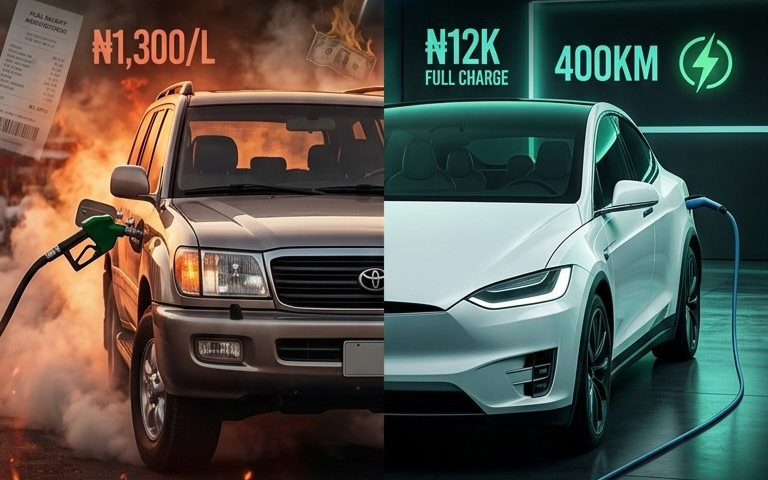
The average Nigerian SUV does around 6 to 8 kilometres per litre in real driving conditions. Not the manufacturer's highway estimate. The actual figure you get in Lagos traffic with the air conditioning running. Petrol is currently sitting at around 1,300 naira per litre. Run those numbers and most people are spending roughly 180 to 220 naira per kilometre. Not per trip. Per kilometre.
What Driving an Electric Car Costs
A typical EV with a 60 kilowatt-hour battery costs around 12,000 naira to fully charge at home on Band A electricity. That same charge gives you approximately 400 kilometres in real Nigerian driving conditions. That works out to roughly 30 naira per kilometre. Read that again slowly. 30 naira per kilometre versus 186 naira per kilometre. That is not a marginal difference you can talk yourself out of. That is a completely different financial reality. The kind of difference that, over a year of daily driving, adds up to money that could buy a second car.
The Hidden Cost Nobody Is Calculating
Here is where it gets uncomfortable. Most people who worry about EV resale value are quietly spending another car's worth every few years on fuel, oil servicing, injector cleaning, gearbox repairs, and generator costs combined. The money leaves gradually enough that it does not feel like a single large loss, but it is. An engine that runs on combustion has hundreds of moving parts under constant stress. Those parts wear. They need oil. They need filters. They need attention every few months.
The bill is always there, just spread out across enough visits to feel normal. An electric motor has a fraction of those moving parts. No oil changes. No fuel injectors. No gearbox in the traditional sense. The maintenance profile is genuinely different, and over time, that difference compounds.
The Honest Part: Nigeria Is Not Fully Ready Yet
Nobody here is pretending the infrastructure situation does not exist. Charging points are limited. Public fast chargers are not yet widespread enough to make long-distance EV travel stress-free. Grid power is unreliable in ways that affect home charging. These are real problems, not excuses invented by people who do not want change.
But the economics are becoming very difficult to argue with. Because the moment someone combines solar panels, home battery storage, and an EV, something significant happens. They are not just cutting their fuel costs. They are slowly removing themselves from dependence on fuel stations entirely. No petrol price increases affect them. No fuel scarcity queues. No monthly calculation of how many litres they can afford this week. That combination is already happening in Nigeria. It is not theoretical. It is just not common enough yet to feel normal.
The Pattern Always Looks the Same
The same people dismissing EVs today will buy a hybrid first. Then, a few years after that, quietly upgrade to full electric. Without making a big announcement about it. This is not a guess. It is a pattern. People mocked touchscreen phones. Then bought iPhones. People mocked online banking. Then stopped going to the branch entirely. People mocked streaming. Then cancelled their cable subscription. The future always sounds unrealistic right before it becomes completely normal. The technology does not wait for everyone to feel comfortable with it. It just keeps getting cheaper, more available, and harder to ignore. The numbers above are already what they are. They are not projections. They are not optimistic estimates. They are the current cost of driving petrol versus the current cost of driving electric, calculated on roads in this country, today.
What Comes Next
In our next piece, we will break down the different ways you can charge an electric car in Nigeria, from home charging on the grid to solar setups to the public charging options currently available. Because understanding the cost is only the first step. Knowing how to make it practical in your actual life is where the real conversation starts. Follow our page so you do not miss it.
At Aladi Autos, we source, inspect and deliver EVs, hybrids and affordable SUVs across Nigeria. If you want honest guidance on making the switch or just understanding your options, reach out.